
The best way to organize chest freezer space is to stop treating it like one big box. A chest freezer is deep, so anything that is not in a bin or basket sinks to the bottom and is forgotten until it is covered in frost. A simple zone system, a few stackable bins and an inventory list on the lid turn it into something you can search in seconds.
This guide walks through a nine-step system that works in any chest freezer, from a 3 cubic foot apartment model to a 20 cubic foot unit in the garage, with food-safety points from FoodSafety.gov.
Quick Answer: The Best Way to Organize Chest Freezer
- Empty and zone itDivide the freezer into zones by food type.
- Use stackable binsBins act like drawers you lift out.
- Freeze flatFlat bags stack upright like files.
- Label everythingContents and date on every package.
- Keep an inventoryA list on the lid or on your phone.
- Rotate stockOldest food on top, newest at the bottom.
The best way to organize chest freezer contents is to zone it by food type, put each zone in a stackable bin, freeze food flat, label every package with the date, and keep an inventory on the lid. Keep the freezer at 0°F or colder, which FoodSafety.gov says keeps food safe indefinitely.
Chest Freezer Zone Plan at a Glance
| Zone | What goes there | Where |
|---|---|---|
| Daily grab | Ice cream, frozen veg, bread | Top basket |
| Proteins | Beef, pork, poultry, fish | Bottom bins by type |
| Meal prep | Soups, casseroles, sauces | Middle bins, flat-frozen |
| Bulk and backup | Extra packs, holiday items | Bottom corners |
| Breast milk or medical ice packs | Clearly labeled bags | Own bin, top layer |
Step-by-Step: The Best Way to Organize Chest Freezer Contents
1. Empty and defrost first
Move food into coolers, unplug, and let frost melt. ENERGY STAR advises defrosting manual-defrost freezers before frost builds past a quarter inch. A clean, dry freezer is the right starting point.
2. Sort food by type
Group proteins, vegetables, prepared meals, desserts and bread. Throw out anything with heavy freezer burn or no label you cannot identify.
3. Measure the inside
Measure interior length, width and depth, and the step where the compressor sits. Many bins are sold for 5 to 7 cubic foot or 10 to 20 cubic foot freezers, so measure before you buy.
4. Choose bins that stack
Open wire or mesh bins let cold air circulate and show what is inside. Handles that fold down allow bins to stack.
5. Assign zones
Put proteins at the bottom, prepared meals in the middle and everyday items in the hanging basket.
6. Freeze flat
Lay soups, ground meat and sauces flat in bags on a tray until frozen, then stand them upright in a bin like files.
7. Label every package
Write the contents, amount and date. A wide marker on freezer tape stays readable in the cold.
8. Build an inventory list
Tape a list inside the lid or keep a shared phone note. Cross items off as you use them.
9. Rotate and review monthly
Move older items up as you add new ones, and check the list once a month.
Organizing Tips for Different Chest Freezer Sizes
Small freezers (under 4 cubic feet)
Use the included baskets for daily items and one or two narrow bins below. Flat-frozen bags make the biggest difference here.
Mid-size freezers (5 to 10 cubic feet)
Four bins usually fit across the bottom. Use color-coded bins for each zone.
Large freezers (12 cubic feet and up)
Divide the floor into a grid of bins and label each bin on the handle. Split-lid freezers can hold everyday food on one side and bulk meat on the other.
Organizing for Specific Needs
Bulk meat and farm shares
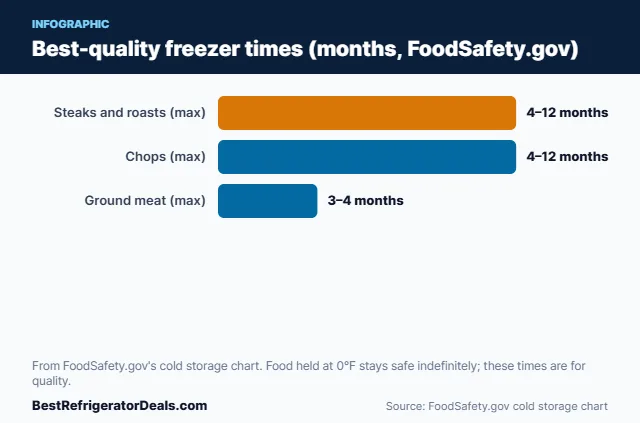
Give each animal or cut its own bin: steaks, roasts, ground meat and bones. Tape the butcher’s cut list to the lid and cross items off. Ground meat has a shorter best-quality window, 3 to 4 months on the FoodSafety.gov chart, so keep it on top where you will use it first.
Weekly meal prep
Freeze soups, chili and sauces in portion-size bags laid flat on a tray. Once frozen, file them upright in a bin by type, with the label facing up so you can read it from above.
Breast milk stash
Give milk its own bin, newest at the back and oldest at the front. The CDC says frozen breast milk is best used within about 6 months and is acceptable up to 12, so a date on every bag matters.
Hunters and anglers
Keep game separate from household food and label each package with species, cut and date. Vacuum-sealed fillets and steaks stack neatly in shallow bins.
Baking and holidays
Butter, flour for long storage, nuts, pie crusts and cookie dough can share a bin. Clear it out after the holidays so it does not fill with forgotten leftovers.
Food Safety While You Organize
Keep it at 0°F or colder
FoodSafety.gov says food kept continuously at 0°F or below can be kept indefinitely; storage times on its chart are for quality.
Work quickly
Use coolers during the reorganization so food stays frozen.
Watch the power
A full freezer holds a safe temperature for about 48 hours in an outage, or about 24 hours if half full and kept closed, according to FoodSafety.gov.
Thaw safely
Thaw food in the refrigerator, in cold water or in the microwave, never on the counter.
Common Mistakes to Avoid
Overfilling to the lid
Leave a little room so the lid closes and seals completely. A lid that does not seal lets in warm, moist air and builds frost quickly.
Putting warm food straight in
Cool cooked food in the refrigerator first. Warm food raises the temperature of nearby packages and adds frost.
Skipping labels
Frozen food looks alike after a few weeks. An unlabeled bag is the one most likely to be thrown away.
Ignoring frost
Frost takes space and makes the freezer work harder. Defrost before it reaches a quarter inch.
Bins that block the drain or seal
Keep bins clear of the lid gasket and the defrost drain plug.
How to Choose Chest Freezer Organizer Bins
Measure inside, not outside
Interior width and depth decide which bins fit. Measure at the bottom and at the step over the compressor, which is usually shallower than the rest of the floor.
Pick the right material
Coated wire and metal mesh bins let cold air reach food and show what is inside. Solid plastic bins protect fragile items but can trap moisture.
Look for fold-down or expandable handles
Handles that fold in let bins stack; handles that lock up let you lift a full bin without reaching to the bottom. Expandable bins can rest on the freezer rim like a hanging basket.
Choose a leak-proof bottom for small items
A fine mesh or solid bottom stops peas, nuts and small packets from slipping through.
Use colors or tags for zones
Colored bins or clip-on tags make zones obvious at a glance, which helps everyone in the household put food back in the right place.
How We Researched the Best Way to Organize Chest Freezer
To build this guide to the best way to organize chest freezer space, we reviewed chest freezer layouts and included baskets on Amazon, looked at the sizes of common freezer organizer bins, and checked food-safety timing against FoodSafety.gov. We also drew on owner feedback about what makes chest freezers hard to use, mainly items sinking to the bottom and forgotten food.
We checked efficiency claims against ENERGY STAR refrigerator guidance and food-safety temperatures against the FDA’s food storage advice (40°F or colder in the fridge, 0°F in the freezer). Our full process is on our How We Test page. We do not list prices or star ratings because they change daily.
Tips for Keeping Your Chest Freezer Organized
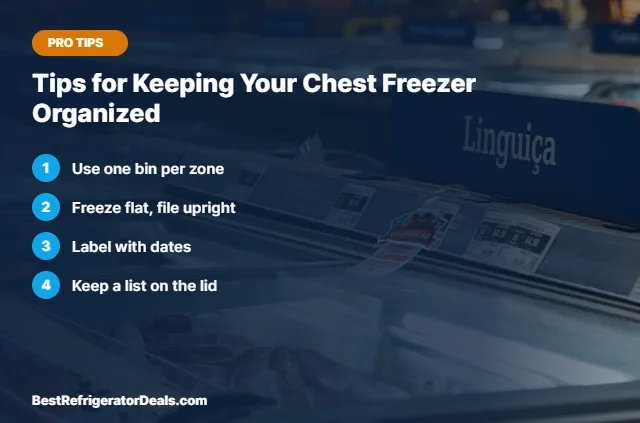
- Keep a marker on the lid. So labeling is easy.
- Use one bin per zone. Lift out, not dig.
- Freeze flat, file upright. Saves space.
- Review the list monthly. Use oldest first.
- Leave space near the top. For new items.
Below are common questions about the best way to organize chest freezer space.
Frequently Asked Questions
What is the best way to organize a chest freezer?
Zone it by food type, use stackable bins, freeze food flat, label everything with a date and keep an inventory on the lid.
What bins work best in a chest freezer?
Open wire or mesh bins with fold-down handles let cold air circulate and stack neatly. Measure your freezer first.
How do I stop food from getting lost at the bottom?
Put everything in bins you can lift out and keep an inventory list.
How long can food stay in a chest freezer?
Food kept at 0°F stays safe indefinitely per FoodSafety.gov; the chart times are for best quality.
How often should I reorganize?
Do a quick review monthly and a full clean-out when you defrost.
Should I organize by date or by type?
By type first, then rotate by date within each zone.
Do I need to buy special bins for a chest freezer?
Not necessarily. Sturdy boxes, reusable shopping bags or bins you already own can work, as long as you can lift them out and they do not block the lid seal.
Final Verdict
The best way to organize chest freezer space is a zone system: bins by food type, flat-frozen bags filed upright, labels with dates and an inventory on the lid. Keep it at 0°F, review it monthly, and the best way to organize chest freezer contents becomes a habit that saves food and money.
Related Guides
More refrigerator research from Best Refrigerator Deals:
Specifications change between model years. Always confirm the exact dimensions, capacity and energy figures on the retailer or manufacturer page before you buy.