
As an Amazon Associate we earn from qualifying purchases. Commissions never affect our picks. Read our affiliate disclaimer.
A basement is the natural home for a second refrigerator, an overflow freezer or a bar fridge, but cool, damp lower levels can be hard on appliances that were designed for kitchens. To find the best fridge for basement use, we compared full-size top-freezers, chest freezers and beverage centers by capacity, installation style, temperature range and how well they suit cooler rooms.
We cover both main jobs a basement fridge does: bulk food storage and a basement bar. You will find our seven picks, a comparison table, and a buying guide on room temperature, moving appliances down stairs and choosing between built-in and freestanding bar fridges.
Quick Answer: The Best Fridge for Basement
- Best OverallSummit FF18 30-Inch
- Best Slim Second FridgeSummit CTR15 28-Inch
- Best Chest FreezerTABU 7.0 Chest
- Best for Basement Bar (Built-In)Icyglee 24-Inch 180-Can
- Best Freestanding Bar FridgeDanby 117-Can
- Best Basement Wine CoolerIvation 12-Bottle
- Best for Unfinished BasementsFrigidaire EFRF5003
For overflow groceries, the Summit FF18 is our best fridge for basement storage: 18 cubic feet, ENERGY STAR certified and frost-free. For a basement bar, the Icyglee 24-inch 180-can cooler can be built in under a counter, and the TABU 7.0 chest freezer handles bulk frozen food.
Best Fridge for Basement Comparison Table
| Product | Best For | Type | Key Feature | Buy |
|---|---|---|---|---|
| Summit FF18 30-Inch | Best Overall | Full-size top freezer | 18 cu ft, ENERGY STAR | Check Price |
| Summit CTR15 28-Inch | Best Slim Second Fridge | Full-size top freezer | 14.3 cu ft in 28" width | Check Price |
| TABU 7.0 Chest | Best Chest Freezer | Chest freezer | 7 cu ft, 22" x 18" footprint | Check Price |
| Icyglee 24-Inch 180-Can | Best for Basement Bar (Built-In) | 24" undercounter beverage fridge | Front vent, 180 cans | Check Price |
| Danby 117-Can | Best Freestanding Bar Fridge | Freestanding beverage center | Door lock, fan-forced cooling | Check Price |
| Ivation 12-Bottle | Best Basement Wine Cooler | Compressor wine cooler | Compressor, 41–64°F | Check Price |
| Frigidaire EFRF5003 | Best for Unfinished Basements | Chest freezer, garage-ready | Garage-ready rating | Check Price |
The 7 Best Fridge for Basement Picks for 2026
Every best fridge for basement pick below fits a specific job, from a full second fridge to an under-counter basement bar cooler.

1. Summit FF18SSIM 30" Top-Freezer Refrigerator, 18 Cu. Ft.
1. A full-size, ENERGY STAR certified second fridge with 18 cubic feet and a 4 cubic foot freezer.
👍 Pros & Cons
Pros
- ENERGY STAR certified full-size
- 18 cu ft with a 4 cu ft freezer
- Frost-free plus ice maker
- Gallon door storage, LED lighting
Cons
- Needs a 30-inch opening
- Stainless finish needs wiping
- Large to move down stairs
📄 Detailed Review
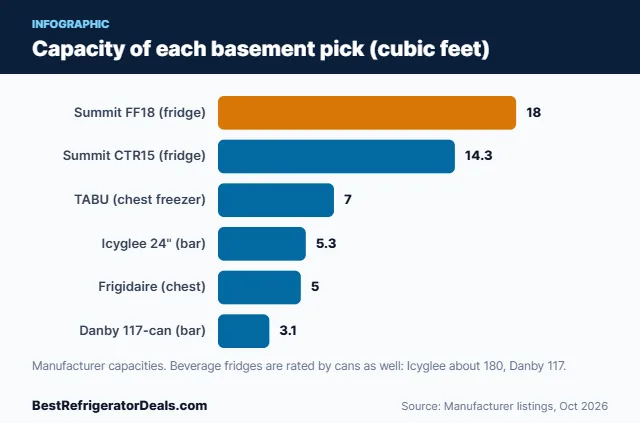
- Capacity: 18 cu ft (4 cu ft freezer)
- Dimensions: 29.75" W x 31.25" D x 66.5" H
- Listed energy use: 447 kWh/year
- Certification: ENERGY STAR
- Defrost: Frost-free
- Extras: Ice maker, LED lighting, humidity crispers
The Summit FF18 is a 30-inch, 18 cubic foot top-freezer refrigerator with ENERGY STAR certification. It pairs a touch thermostat in the fresh-food section with dial controls for the 4 cubic foot freezer, and adds LED lighting, gallon door storage, humidity-controlled crispers and a built-in ice maker.
A basement second fridge often holds bulk drinks, holiday overflow and big-box groceries. Eighteen cubic feet handles that, and frost-free operation means the freezer will not ice up in a space you visit less often. Measure stairways and doorways first: it is 29.75 inches wide.

2. Summit CTR15SSIMLHD 28" Top-Freezer Refrigerator with Ice Maker
2. Full-size storage and an ice maker in a 28-inch width that is easier to carry down narrow stairs.
👍 Pros & Cons
Pros
- Full-size storage in a 28-inch width
- Frost-free with ice maker
- Two humidity-controlled crispers
- Gallon-size door racks
Cons
- Left-hand door swing only on this listing
- Needs a dedicated 28-inch opening
- Higher energy use than compacts
📄 Detailed Review
- Capacity: 14.3 cu ft
- Dimensions: 27.75" W x 27.88" D x 67.5" H
- Listed energy use: 416 kWh/year
- Defrost: Frost-free
- Freezer: SuperFreeze setting, ice maker
- Door swing: Left-hand
Summit’s CTR15 is a 28-inch-wide, full-size top-freezer refrigerator with 14.3 cubic feet of space. It is frost-free, includes a built-in ice maker, two humidity-controlled crispers, spill-proof glass shelves and a SuperFreeze setting for newly loaded food. This listing has a left-hand door swing.
Narrow basement stairs and tight landings are common. The 28-inch body is easier to maneuver than a 30- or 33-inch fridge while still offering 14.3 cubic feet, humidity-controlled crispers and an ice maker.
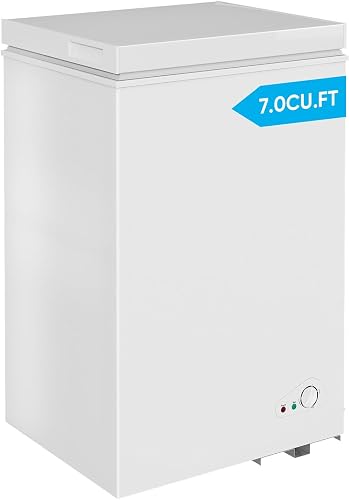
3. TABU 7.0 Cu. Ft. Compact Chest Freezer
3. A compact 7 cubic foot chest freezer for bulk meat, batch cooking and holiday food.
👍 Pros & Cons
Pros
- 7 cu ft in a 22 x 18 inch footprint
- Front-facing 7-level dial
- Lid stays open at 45–90°
- Removable basket
Cons
- Manual defrost
- Newer brand with shorter track record
- Chest layout makes deep items harder to reach
📄 Detailed Review
- Capacity: 7.0 cu ft
- Dimensions: 22" W x 18" D x 34" H
- Temperature: -7.6°F to 6.8°F, 7 levels
- Noise: 40 dB or less (manufacturer)
- Refrigerant: R600a
- Defrost: Manual
The TABU 7.0 is a compact chest freezer with a small 22 x 18 inch footprint. A front-facing seven-level dial ranges from -7.6°F to 6.8°F, the hinged lid holds open between 45 and 90 degrees, and the maker rates it at 40 dB or less.
Chest freezers suit basements well because cold air stays in when the lid opens. The 22 x 18 inch footprint fits beside a washer or under stairs, and the front dial makes temperature changes easy.

4. Icyglee 24" Built-In Beverage Refrigerator, 180 Cans
4. A 24-inch under-counter beverage fridge with front venting for a built-in basement bar.
👍 Pros & Cons
Pros
- Front venting for true under-counter install
- 180-can capacity
- Frost-free air circulation
- ETL certified, low listed kWh
Cons
- Does not chill below 37°F
- 24-inch cutout required
- Heavier than freestanding coolers
📄 Detailed Review
- Capacity: 180 cans, 5.3 cu ft
- Dimensions: 23.4" W x 22.6" D x 34.25" H
- Temperature: 37–65°F
- Listed energy use: 175 kWh/year
- Installation: Built-in or freestanding (front vent)
- Cooling: Frost-free fan circulation
Icyglee’s 24-inch beverage refrigerator is designed to slide under a counter thanks to front ventilation. It holds about 180 cans in 5.3 cubic feet, uses frost-free air circulation, runs 37–65°F and lists 175 kWh per year. The unit is ETL certified.
If you are finishing a basement bar with cabinets, front venting is essential, because rear-vented coolers overheat when boxed in. This unit holds about 180 cans and lists only 175 kWh a year.

5. Danby DBC117A2BSSDB-6 117-Can Beverage Center
5. A freestanding 117-can beverage center with a lock, ideal for a basement bar or rec room.
👍 Pros & Cons
Pros
- Door lock for shared spaces
- Fan-forced cooling for even temperatures
- Low listed energy use
- Smooth back can sit near a wall
Cons
- Mechanical dial, no digital display
- Freestanding only
- Glass door adds heat gain in sunny rooms
📄 Detailed Review
- Capacity: 117 cans, 3.1 cu ft
- Temperature: 35.6–50°F (mechanical thermostat)
- Listed energy use: 181 kWh/year
- Cooling: Fan-forced
- Shelves: 4 adjustable
- Extras: Door lock, blue LED, reversible door
Danby’s DBC117A2BSSDB-6 holds up to 117 cans in 3.1 cubic feet. Fan-forced cooling keeps temperatures even, the thermostat reaches 35.6°F, and a door lock, blue LED lighting and four adjustable shelves suit shared rooms. Listed energy use is 181 kWh per year.
For a bar area without built-in cabinets, a freestanding glass-door cooler is the simplest choice. The lock is useful when kids or guests use the basement, and fan-forced cooling keeps cans evenly cold.

6. Ivation 12-Bottle Compressor Wine Cooler
6. A slim 12-bottle compressor wine cooler for a basement bar or tasting nook.
👍 Pros & Cons
Pros
- Under 10 inches wide
- Compressor holds steady in warm rooms
- Lock and UV glass
- Low listed 115 kWh/year
Cons
- Wine only, not cans
- 12-bottle limit
- Freestanding only
📄 Detailed Review
- Capacity: 12 bottles, 1.2 cu ft
- Dimensions: 9.92" W x 17.72" D x 31.18" H
- Temperature: 41–64°F, digital touch
- Listed energy use: 115 kWh/year
- Door: UV-resistant double-pane glass with lock
- Cooling: Compressor with fan
Ivation’s 12-bottle wine cooler is under 10 inches wide yet uses a compressor and fan for stable temperatures between 41 and 64°F. It adds a lock, UV-resistant double-pane glass, LED lighting and removable racks, and lists 115 kWh per year.
Basements are often the most stable place in a home for wine. This compressor cooler adds precise 41–64°F control in a footprint under 10 inches wide, with UV-resistant glass and a lock.

7. Frigidaire EFRF5003 Garage-Ready 5.0 Cu. Ft. Chest Freezer
7. A 5.0 cubic foot chest freezer the maker markets as garage-ready, a safer bet for unheated lower levels.
👍 Pros & Cons
Pros
- Marketed as garage-ready
- Exterior defrost drain
- Power-on indicator light
- Compact chest footprint
Cons
- Manual defrost
- Chest layout needs top clearance
- No interior lock
📄 Detailed Review
- Capacity: 5.0 cu ft
- Dimensions: 28" W x 23" D x 35" H
- Rating: Garage-ready (manufacturer)
- Thermostat: 7 settings
- Storage: Removable vinyl-coated basket
- Defrost: Manual, exterior drain
Frigidaire’s EFRF5003 is a 5.0 cubic foot chest freezer that the manufacturer markets as garage-ready. A seven-setting thermostat, removable wire basket, exterior defrost drain and power-on light keep it simple to run in a utility space.
In an unfinished basement that gets cold in winter, a garage-ready freezer is designed to cope with wider room temperatures than a standard kitchen appliance. The exterior drain makes defrosting easier on a concrete floor.
How We Chose the Best Fridge for Basement
To choose the best fridge for basement use, we split the job into storage (second fridge or freezer) and entertaining (basement bar). We compared capacity, footprint and width for stairways, frost-free versus manual defrost, built-in versus freestanding venting, and listed energy use. We also looked for garage-ready ratings for colder spaces and read verified owner reviews for reliability patterns.
We checked efficiency claims against ENERGY STAR refrigerator guidance and food-safety temperatures against the FDA’s food storage advice (40°F or colder in the fridge, 0°F in the freezer). Our full process is explained on our How We Test page. We do not list prices or star ratings because they change daily.
Basement and Basement Bar Fridge Buying Guide
Check your basement temperature
Most standard refrigerators are designed for rooms roughly between the 50s and 90s Fahrenheit. In an unheated basement that drops below that range in winter, a fridge’s compressor may run too little to keep the freezer cold. For cold or unfinished basements, consider a model the maker labels garage-ready, or keep the space heated.
Measure stairs, landings and doorways
The most common basement fridge mistake is a unit that will not make the turn at the bottom of the stairs. Measure width, height and diagonal clearance. Removing doors helps, and slimmer 28-inch models are easier to move than 30- to 33-inch fridges.
Basement bar: built-in needs front venting
Under-counter beverage fridges for a basement bar must vent at the front. Rear-vented coolers placed inside cabinetry trap heat, run constantly and can fail early. Freestanding glass-door units are fine on an open wall with a few inches of clearance.
Plan for humidity and power
Basements can be damp. Keep the fridge off bare concrete if water ever pools, leave airflow space and plug it into a dedicated, properly grounded outlet rather than an extension cord.
Choose chest or upright freezer by habit
Chest freezers are typically more efficient and hold cold longer during outages. Upright freezers make it easier to see and rotate food. In a basement used for bulk storage, a chest freezer is usually the better value.
Setup Tips for the Best Fridge for Basement Use
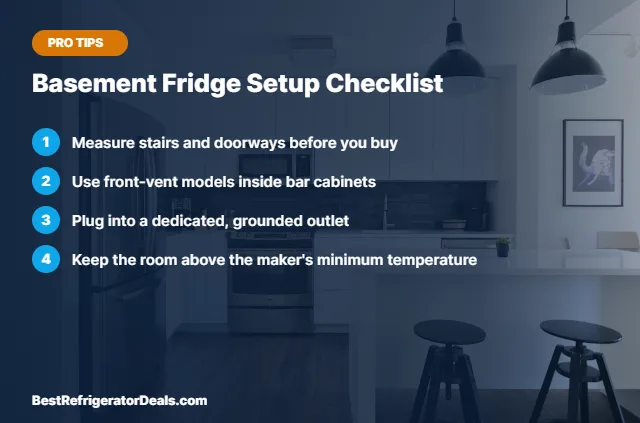
- Level it on a solid base. Use leveling feet or a pad so doors close and seal properly.
- Leave airflow space. Keep a few inches around vents, especially in finished bars.
- Use a dedicated outlet. Avoid extension cords for full-size fridges and freezers.
- Add a thermometer. Check the fridge stays at 40°F and the freezer at 0°F.
- Watch winter temperatures. Cold basements can let freezers warm; heat the space or choose garage-ready.
Here are answers to common questions about choosing the best fridge for basement spaces and basement bars.
Frequently Asked Questions
What is the best fridge for basement storage?
For bulk food storage, the best fridge for basement use is a full-size, frost-free model such as the ENERGY STAR Summit FF18. If stairs are tight, the 28-inch Summit CTR15 is easier to carry down.
What is the best fridge for a basement bar?
For a built-in basement bar, choose a front-venting under-counter beverage fridge such as the Icyglee 24-inch. For an open bar wall, a freestanding glass-door cooler like the Danby 117-can center works well.
Can a regular refrigerator go in an unheated basement?
It can if the basement stays within the temperature range the manufacturer specifies. In basements that get cold in winter, a garage-ready model or keeping the space heated is the safer choice.
Is a chest freezer good for a basement?
Yes. Chest freezers suit basements because they are usually efficient, hold cold well during power outages and fit under stairs or beside laundry appliances.
Does a basement fridge raise my electric bill much?
A second full-size fridge typically adds a few hundred kWh a year. Choosing ENERGY STAR, keeping it reasonably full and avoiding a very old second fridge keeps the cost down.
Final Verdict
Our final pick for the best fridge for basement storage is the Summit FF18 30-Inch. For a basement bar, choose the built-in Icyglee 24-Inch 180-Can, and add the TABU 7.0 Chest if you need bulk freezer space.
Related Guides
More refrigerator research from Best Refrigerator Deals:
Prices and availability change often. Check the retailer listing for the current price, warranty and exact dimensions before you buy.