
As an Amazon Associate we earn from qualifying purchases. Commissions never affect our picks. Read our affiliate disclaimer.
The best lab refrigerator holds a stable, uniform temperature, recovers quickly after the door opens, and tells you when something goes wrong. Household fridges cycle widely and have cold spots, which is fine for lunch but not for reagents, media or samples. Lab units add forced-air circulation, digital controllers, alarms and sometimes battery-backed monitoring.
We compared laboratory and pharmaceutical refrigerators sold on Amazon on uniformity, alarms, capacity and monitoring, and included one low-temperature freezer for labs that need it.
Quick Answer: The Best Lab Refrigerator
- Best OverallAcross Intl 4.2
- Best UprightAccucold ARG8PV
- Best Large With WiFiConserv 12.7 Pharmacy
- Best CompactAccucold ACR21W
- Best Budget CompactAccucold FF28LWHPRO
- Best Low-Temp FreezerSummit EL11LT
Across International 4.2 is the best lab refrigerator for most small labs: ±2°C uniformity, power-failure and sensor alarms, and a backup battery for its alarms. Accucold ARG8PV is the larger forced-air upright, Conserv 12.7 adds WiFi, Accucold ACR21W is a compact unit with a buffered probe, Accucold FF28LWHPRO is a budget general-purpose compact, and Summit EL11LT is a -45°C capable chest freezer.
Best Lab Refrigerator Comparison Table
| Product | Best For | Type | Key Feature | Buy |
|---|---|---|---|---|
| Across Intl 4.2 | Best Overall | Countertop pharmacy refrigerator | ±2°C, alarms, backup battery | Check Price |
| Accucold ARG8PV | Best Upright | Purpose-built vaccine refrigerator | 8 cu ft, forced air | Check Price |
| Conserv 12.7 Pharmacy | Best Large With WiFi | Upright pharmacy refrigerator | 12.7 cu ft, WiFi | Check Price |
| Accucold ACR21W | Best Compact | Compact medical refrigerator | Buffered probe, readout | Check Price |
| Accucold FF28LWHPRO | Best Budget Compact | General-purpose compact refrigerator | Fan, digital thermostat | Check Price |
| Summit EL11LT | Best Low-Temp Freezer | Low-temperature commercial chest freezer | -45°C capable, lock | Check Price |
The 6 Picks We Recommend
Never store flammable solvents in a standard refrigerator; use a unit specifically rated for flammable materials. Check your institution’s requirements before buying.

1. Across International 4.2 Cu. Ft. 2–8°C Pharmacy Vaccine Refrigerator
1. Across International covers the alarms labs need.
👍 Pros & Cons
Pros
- Backup battery for alarms
- Power-failure alarm
- Built to CDC/VFC guidance (brand)
- Wide countertop format
Cons
- Wide
- 1-year warranty
- Not NSF 456 listed
📄 Detailed Review
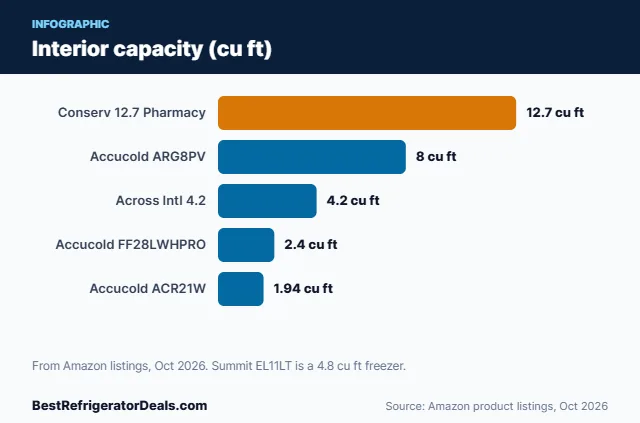
- Capacity: 4.2 cu ft
- Dimensions: 32" W x 23.5" D x 25" H
- Uniformity: ±2°C
- Alarms: Audio and visual
- Protection: Power, sensor, high/low, backup battery
- Listing: UL
Across International’s 4.2 cubic foot unit holds 2–8°C with ±2°C uniformity and alarms for power failure, sensor failure and high or low temperature, backed by a battery.
Power, sensor and high/low temperature protection.

2. Accucold ARG8PV 8 Cu. Ft. Vaccine Refrigerator, Glass Door
2. Accucold ARG8PV recovers quickly after door openings.
👍 Pros & Cons
Pros
- Forced-air cooling recovers fast
- Min/max memory
- Lock
- ETL and UL-471
Cons
- Expensive
- 50 inches tall
- 1-year warranty
📄 Detailed Review
- Capacity: 8 cu ft
- Dimensions: 23.38" W x 24.38" D x 50" H
- Range: +2°C to +8°C
- Cooling: Forced air with internal fans
- Monitoring: Min/max display, audible and visual alarms
- Security: Lock, 2 keys
Accucold’s ARG8PV is an 8 cubic foot purpose-built vaccine refrigerator with forced-air fans for even temperatures and fast recovery after door openings, a min/max display, alarms and a lock.
Min/max display and lock.

3. Conserv 24-Inch Commercial Pharmacy Refrigerator, 12.7 Cu. Ft., WiFi
3. Conserv alerts you remotely.
👍 Pros & Cons
Pros
- Large capacity
- WiFi alerts
- Locking glass door
- No-frost
Cons
- 64 inches tall
- Not NSF 456 listed
- Few reviews
📄 Detailed Review
- Capacity: 12.7 cu ft
- Dimensions: 23.4" W x 28" D x 64" H
- Range: 35.8°F to 46.4°F
- Monitoring: WiFi, high/low and door alarms
- Door: Locking glass, LED lighting
- Noise: 43 dB (listed)
Conserv’s 12.7 cubic foot upright pharmacy refrigerator holds 35.8°F to 46.4°F, adds WiFi monitoring with temperature and door alarms, and has a locking glass door.
Locking glass door.

4. Accucold ACR21W 1.94 Cu. Ft. Compact Medical Refrigerator
4. ACR21W suits small benches.
👍 Pros & Cons
Pros
- External temperature readout
- Self-closing door
- Compact
- Buffered probe
Cons
- No NSF 456 listing
- Small
- Expensive vs household minis
📄 Detailed Review
- Capacity: 1.94 cu ft (55 L)
- Dimensions: 18.88" W x 21.38" D x 23.13" H
- Monitoring: External readout, high/low
- Probe: Buffered
- Door: Solid, self-closing
- Use: Pharmaceutical storage
Accucold’s ACR21W is a 1.94 cubic foot pharmaceutical refrigerator with an outside readout of current and high/low temperatures, a buffered probe and a self-closing solid door.
Self-closing door.

5. Accucold FF28LWHPRO 2.4 Cu. Ft. Compact Refrigerator
5. Accucold FF28LWHPRO is a general-purpose compact.
👍 Pros & Cons
Pros
- Internal fan for even temperature
- Automatic defrost
- Compact
- Lab-brand build
Cons
- Not a vaccine-grade unit
- No lock listed
- No external alarm
📄 Detailed Review
- Capacity: 2.4 cu ft (68 L)
- Dimensions: 18.5" W x 17.75" D x 24.88" H
- Control: Digital thermostat, internal fan
- Defrost: Automatic
- Refrigerant: Hydrocarbon, CARB compliant
- Warranty: 1 year
Accucold’s FF28LWHPRO is a general-purpose 2.4 cubic foot compact refrigerator with an internal fan and digital thermostat for steadier temperatures than a typical dorm fridge.
Not for vaccines or critical samples.

6. Summit EL11LT 4.8 Cu. Ft. Chest Freezer with Lock
6. Summit EL11LT handles samples that need deep cold.
👍 Pros & Cons
Pros
- Factory-installed lock
- Digital thermostat with external controls
- 4.5-inch insulation
- Very low temperature capability
Cons
- Expensive for 4.8 cu ft
- Commercial look
- Overkill for ordinary groceries
📄 Detailed Review
- Capacity: 4.8 cu ft
- Dimensions: 29" W x 27" D x 34" H
- Temperature: Capable of -45°C operation
- Listing: UL-S listed to NSF-7
- Lock: Factory-installed
- Warranty: 1 yr parts/labor, 5 yr compressor
Summit’s EL11LT is a commercial-grade 4.8 cubic foot chest freezer with a digital thermostat, a factory-installed lock, extra-thick 4.5-inch insulation and the ability to run as cold as -45°C, which is why labs and clinics use it.
UL-S listed to NSF-7.
How We Chose the Best Lab Refrigerator
To choose the best lab refrigerator, we compared insulin coolers, GLP-1 pen cases and medication refrigerators sold on Amazon in the U.S. on how they cool (ice or gel packs, evaporative wallets, battery or plug-in electric, compressor), the temperature range each maker lists, how long passive cases say they stay cool, capacity in pens or vials, monitoring features such as displays and alarms, and locks. We read owner reviews for coolers that froze medication, displays that drifted and cases that ran warm. We are not medical professionals; always follow the storage directions on your medicine’s label and your pharmacist’s advice.
We checked storage guidance against the CDC’s vaccine storage unit guidance (NSF/ANSI 456 units preferred, never dormitory-style units, 2°C to 8°C for refrigerators) and insulin storage against the FDA’s insulin storage guidance. Our full process is explained on our How We Test page. We do not list prices or star ratings because they change daily.
How to Choose the Best Lab Refrigerator
Define the temperature you need
Refrigerated, frozen or ultra-low.
Uniformity and recovery
Forced-air units hold more even temperatures.
Alarms and monitoring
High/low, door and power-failure alarms protect samples.
Flammables need special units
Do not use standard units for flammable solvents.
Calibration
Some units ship with calibration certificates.
Security
Locks protect controlled materials.
Service and warranty
Compare parts, labor and compressor coverage.
Forced air versus static cooling
Static cooling relies on cold walls and natural convection, so the top and bottom of the cabinet can differ by several degrees. Forced-air units use fans to move air past the evaporator and around the contents, which evens out temperatures and helps the cabinet recover after the door is opened. For anything temperature-critical, forced air is worth paying for.
Glass door or solid door?
Glass doors let you check inventory without opening the unit, which reduces temperature swings in a busy lab. Solid doors insulate better and keep light out, which matters for light-sensitive reagents and media.
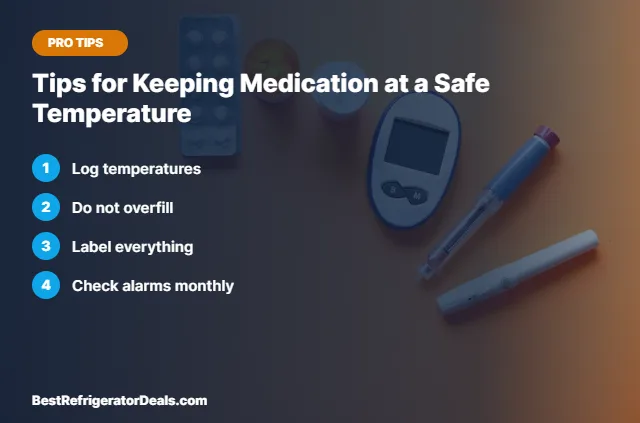
Tips for Keeping Medication at a Safe Temperature
- Log temperatures. Daily or continuous.
- Do not overfill. Air must circulate.
- Label everything. Owner and date.
- Check alarms monthly. Test them.
Below are common questions readers ask about choosing the best lab refrigerator.
Frequently Asked Questions
What is the best lab refrigerator?
Across International 4.2 for small labs, Accucold ARG8PV for an upright.
Can I use a household fridge in a lab?
For non-critical items perhaps, but not for flammables or temperature-sensitive samples.
What is a flammable-material refrigerator?
A unit designed so its electrical parts cannot ignite vapors inside; use one for solvents.
Do lab refrigerators need calibration?
Many labs require calibrated monitoring; check your protocols.
What temperature should a lab refrigerator be?
Most are set between 2°C and 8°C, but follow your protocol.
Should a lab refrigerator have a lock?
For controlled substances or shared spaces, yes; many lab units include a keyed lock.
Final Verdict
Across International 4.2 is the best lab refrigerator for most small labs, with Accucold ARG8PV and Conserv 12.7 for larger needs. Match alarms and uniformity to your samples when choosing the best lab refrigerator.
Related Guides
More refrigerator research from Best Refrigerator Deals:
Prices and availability change often. Check the retailer listing for the current price, warranty and exact dimensions before you buy.