
As an Amazon Associate we earn from qualifying purchases. Commissions never affect our picks. Read our affiliate disclaimer.
The best medication refrigerator holds your medicines inside their labeled range, most often 36°F to 46°F, without freezing them or letting them drift warm when the door opens. For a home with one or two refrigerated prescriptions, a good compact fridge and a thermometer may be enough. For a clinic, care home or pharmacy, purpose-built units with alarms and buffered probes are the safer choice.
We compared medication refrigerators on Amazon from compact household-style units to purpose-built medical refrigerators.
Quick Answer: The Best Medication Refrigerator
- Best OverallAccucold ACR21W
- Best for ClinicsAccucold ACR45L
- Best WiFiConserv 3.9 Pharmacy
- Best AlarmsAcross Intl 4.2
- Best BudgetAccucold FF28LWHPRO
- Best Lockable MiniSmad 1.0 Lockable
Accucold ACR21W is the best medication refrigerator for homes and small offices that want medical-grade control in a compact size. Accucold ACR45L is the undercounter clinic pick, Conserv 3.9 adds WiFi alerts, Across International 4.2 has power-failure alarms with battery backup, Accucold FF28LWHPRO is a budget general compact and Smad 1.0 is the lockable mini.
Best Medication Refrigerator Comparison Table
| Product | Best For | Type | Key Feature | Buy |
|---|---|---|---|---|
| Accucold ACR21W | Best Overall | Compact medical refrigerator | External readout, buffered probe | Check Price |
| Accucold ACR45L | Best for Clinics | Purpose-built undercounter vaccine refrigerator | Lock, alarms, ADA height | Check Price |
| Conserv 3.9 Pharmacy | Best WiFi | Pharmacy refrigerator | Remote alerts | Check Price |
| Across Intl 4.2 | Best Alarms | Countertop pharmacy refrigerator | Power-failure alarm, backup battery | Check Price |
| Accucold FF28LWHPRO | Best Budget | General-purpose compact refrigerator | Fan, digital thermostat | Check Price |
| Smad 1.0 Lockable | Best Lockable Mini | Lockable mini fridge | Lock, 12V/110V | Check Price |
The 6 Picks We Recommend
Never store medicines in a freezer compartment or against the cooling plate. This guide is for information only. Always follow the storage directions on your medicine label and ask your pharmacist or doctor if you are unsure.

1. Accucold ACR21W 1.94 Cu. Ft. Compact Medical Refrigerator
1. ACR21W shows current and high/low temperatures outside.
👍 Pros & Cons
Pros
- External temperature readout
- Self-closing door
- Compact
- Buffered probe
Cons
- No NSF 456 listing
- Small
- Expensive vs household minis
📄 Detailed Review
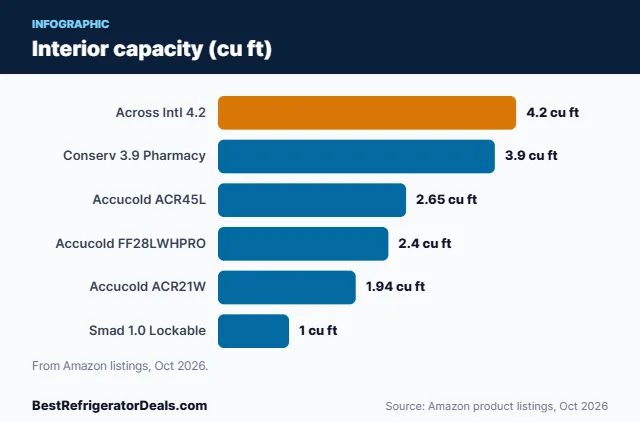
- Capacity: 1.94 cu ft (55 L)
- Dimensions: 18.88" W x 21.38" D x 23.13" H
- Monitoring: External readout, high/low
- Probe: Buffered
- Door: Solid, self-closing
- Use: Pharmaceutical storage
Accucold’s ACR21W is a 1.94 cubic foot pharmaceutical refrigerator with an outside readout of current and high/low temperatures, a buffered probe and a self-closing solid door.
Self-closing door.

2. Accucold ACR45L 2.65 Cu. Ft. Vaccine Refrigerator, ADA, White
2. ACR45L is purpose-built for vaccines and medicines.
👍 Pros & Cons
Pros
- Solid door for stability
- Keyed lock and self-closing door
- Hospital-grade cord
- Longer warranty than most
Cons
- Expensive
- Can’t see contents without opening
- Small capacity
📄 Detailed Review
- Capacity: 2.65 cu ft (75 L)
- Dimensions: 19.5" W x 22.75" D x 31.5" H
- Range: 2–8°C operation
- Monitoring: Buffered probe in glycol bottle, alarms
- Security: Keyed lock, self-closing door
- Warranty: 2 yr parts/labor, 5 yr compressor
Accucold’s ACR45L is the solid-door version of its ADA-height medical refrigerator, with a buffered probe in a glycol bottle, audible alarms, a keyed lock, a self-closing door and a two-year parts and labor warranty.
Strong warranty.

3. Conserv 24-Inch Pharmacy Refrigerator, 3.9 Cu. Ft., WiFi, Lock and Alarm
3. Conserv alerts you if temperature drifts.
👍 Pros & Cons
Pros
- WiFi monitoring
- Door and temperature alarms
- Lock
- Built-in or freestanding
Cons
- Not NSF/ANSI 456 listed
- 1-year warranty
- Pricier than household minis
📄 Detailed Review
- Capacity: 3.9 cu ft
- Dimensions: 24" W x 21.2" D x 35" H
- Defrost: No frost
- Monitoring: WiFi
- Alarms: High/low temperature and door open
- Listing: ETL, lock
Conserv’s 24-inch pharmacy refrigerator is a 3.9 cubic foot frost-free unit with WiFi monitoring, high/low and open-door alarms, a lock and an electronic control panel.
Door alarm and lock.

4. Across International 4.2 Cu. Ft. 2–8°C Pharmacy Vaccine Refrigerator
4. Across International warns you of outages.
👍 Pros & Cons
Pros
- Backup battery for alarms
- Power-failure alarm
- Built to CDC/VFC guidance (brand)
- Wide countertop format
Cons
- Wide
- 1-year warranty
- Not NSF 456 listed
📄 Detailed Review
- Capacity: 4.2 cu ft
- Dimensions: 32" W x 23.5" D x 25" H
- Uniformity: ±2°C
- Alarms: Audio and visual
- Protection: Power, sensor, high/low, backup battery
- Listing: UL
Across International’s 4.2 cubic foot unit holds 2–8°C with ±2°C uniformity and alarms for power failure, sensor failure and high or low temperature, backed by a battery.
±2°C uniformity.

5. Accucold FF28LWHPRO 2.4 Cu. Ft. Compact Refrigerator
5. A general compact with steadier temperatures than dorm fridges.
👍 Pros & Cons
Pros
- Internal fan for even temperature
- Automatic defrost
- Compact
- Lab-brand build
Cons
- Not a vaccine-grade unit
- No lock listed
- No external alarm
📄 Detailed Review
- Capacity: 2.4 cu ft (68 L)
- Dimensions: 18.5" W x 17.75" D x 24.88" H
- Control: Digital thermostat, internal fan
- Defrost: Automatic
- Refrigerant: Hydrocarbon, CARB compliant
- Warranty: 1 year
Accucold’s FF28LWHPRO is a general-purpose 2.4 cubic foot compact refrigerator with an internal fan and digital thermostat for steadier temperatures than a typical dorm fridge.
Not for vaccines.

6. Smad 1.0 Cu. Ft. Mini Fridge with Lock and Key, 12V/110V
6. Smad keeps medicine locked away at home.
👍 Pros & Cons
Pros
- Lock and key
- Runs on 12V or 110V
- Quiet
- Reversible door
Cons
- Lower setting can reach freezing
- No external readout
- Add a thermometer for meds
📄 Detailed Review
- Capacity: 1.0 cu ft
- Dimensions: 15.75" W x 17.32" D x 19.68" H
- Range: 32–50°F
- Power: 110V AC and 12V DC
- Lock: Lock and key
- Listing: CE, ETL
Smad’s 1 cubic foot mini fridge has a lock and key, runs on 110V or 12V and lets you set 32°F to 50°F; for medicine, set it in the middle and verify with a thermometer.
Verify with a thermometer.
How We Chose the Best Medication Refrigerator
To choose the best medication refrigerator, we compared insulin coolers, GLP-1 pen cases and medication refrigerators sold on Amazon in the U.S. on how they cool (ice or gel packs, evaporative wallets, battery or plug-in electric, compressor), the temperature range each maker lists, how long passive cases say they stay cool, capacity in pens or vials, monitoring features such as displays and alarms, and locks. We read owner reviews for coolers that froze medication, displays that drifted and cases that ran warm. We are not medical professionals; always follow the storage directions on your medicine’s label and your pharmacist’s advice.
We checked storage temperatures against the FDA’s insulin storage guidance (36°F to 46°F in a refrigerator, up to 28 days between 59°F and 86°F for most vials and cartridges, never frozen), the official labels for Ozempic and Mounjaro on DailyMed, and the CDC’s vaccine storage unit guidance. Our full process is explained on our How We Test page. We do not list prices or star ratings because they change daily.
How to Choose the Best Medication Refrigerator
Know your range
Most refrigerated medicines are labeled 36°F to 46°F; some differ.
Avoid freezing
Keep items off the back wall and out of freezer compartments.
Monitor
Use an external readout or a thermometer.
Alarms
High/low alarms prevent losses.
Size
Do not overcrowd; air must circulate.
Locks
Protect medicines from children and others.
Placement
A cool, ventilated room helps stability.
Home or clinic?
Clinics should follow CDC and program requirements; homes have more flexibility.
Power backup
Know how long your medicines can stay out of range.
How to set up a new medicine fridge
Let a new unit stand upright for the time the manual specifies before plugging it in, then run it empty for a day with a thermometer inside. Only load medicines once it has held the target range steadily. Set dial thermostats to the middle and adjust in small steps, checking a few hours after each change.
Where to put the thermometer
Place the probe or thermometer in the middle of the cabinet, near the medicines, not against the walls or in the door. Buffered probes, sealed in glycol or a similar material, change temperature more slowly and better reflect what the medicine itself experiences.
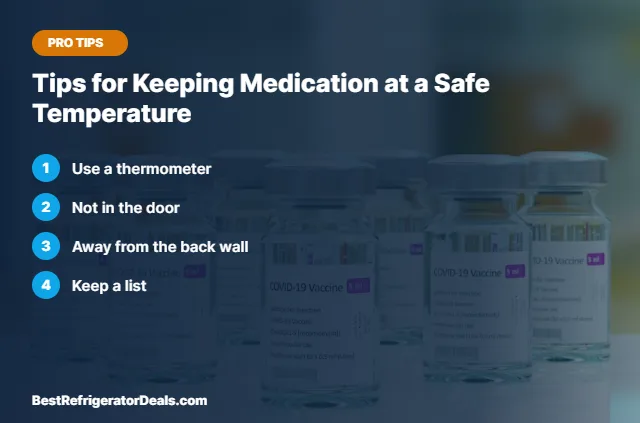
Tips for Keeping Medication at a Safe Temperature
- Use a thermometer. Check daily.
- Not in the door. Temperature swings.
- Away from the back wall. Freeze risk.
- Keep a list. Know what is inside.
Below are common questions readers ask about choosing the best medication refrigerator.
Frequently Asked Questions
What is the best medication refrigerator?
Accucold ACR21W for homes and small offices, ACR45L for clinics.
Can I keep medicine in my kitchen fridge?
Often yes, in the main compartment away from the freezer; check the label.
What temperature should a medication refrigerator be?
Usually 36°F to 46°F; follow your label.
Do I need alarms?
For expensive or critical medicines, alarms are worth it.
Can I use a dorm fridge?
For vaccines the CDC says never; for other medicines, verify the temperature carefully.
Final Verdict
Accucold ACR21W is the best medication refrigerator for homes and small offices, with ACR45L for clinics and Conserv 3.9 for WiFi alerts. Monitor the temperature in whichever best medication refrigerator you choose.
Related Guides
More refrigerator research from Best Refrigerator Deals:
Prices and availability change often. Check the retailer listing for the current price, warranty and exact dimensions before you buy.