
As an Amazon Associate we earn from qualifying purchases. Commissions never affect our picks. Read our affiliate disclaimer.
The best mini fridge for insulin is one that can hold the FDA’s 36°F to 46°F refrigerator range steadily in the room where you put it, without freezing anything. That rules out a lot of tiny drink coolers, which are often thermoelectric and can only cool a set amount below room temperature, and it means checking any mini fridge with a thermometer before you trust it.
We compared mini fridges on Amazon on cooling type, temperature control, size and extras like locks.
Quick Answer: The Best Mini Fridge For Insulin
- Best OverallAccucold FF28LWHPRO
- Best Medical GradeAccucold ACR21W
- Best LockableSmad 1.0 Lockable
- Best SilentSMETA 1.0 Lockable
- Best Digital SetpointCooluli 20L Digital
- SmallestCooluli Classic 4L
Accucold FF28LWHPRO is the best mini fridge for insulin for most people who want a dedicated small fridge: a compact compressor unit with an internal fan and digital thermostat. Accucold ACR21W is the medical-grade step up, Smad 1.0 and SMETA 1.0 add locks, Cooluli 20L has a digital setpoint, and Cooluli 4L is only for a cool, air-conditioned room.
Best Mini Fridge For Insulin Comparison Table
| Product | Best For | Type | Key Feature | Buy |
|---|---|---|---|---|
| Accucold FF28LWHPRO | Best Overall | General-purpose compact refrigerator | Compressor, fan, digital thermostat | Check Price |
| Accucold ACR21W | Best Medical Grade | Compact medical refrigerator | Readout, buffered probe | Check Price |
| Smad 1.0 Lockable | Best Lockable | Lockable mini fridge | Lock, 32–50°F | Check Price |
| SMETA 1.0 Lockable | Best Silent | Lockable absorption mini fridge | Absorption, lock, UL | Check Price |
| Cooluli 20L Digital | Best Digital Setpoint | Thermoelectric mini fridge | Display, glass door | Check Price |
| Cooluli Classic 4L | Smallest | Thermoelectric personal cooler | 4 L, thermoelectric | Check Price |
The 6 Picks We Recommend
Whatever you buy, place a thermometer on the shelf with your insulin. This guide is for information only. Always follow the storage directions on your medicine label and ask your pharmacist or doctor if you are unsure.

1. Accucold FF28LWHPRO 2.4 Cu. Ft. Compact Refrigerator
1. Accucold’s compact holds steadier temperatures than dorm fridges.
👍 Pros & Cons
Pros
- Internal fan for even temperature
- Automatic defrost
- Compact
- Lab-brand build
Cons
- Not a vaccine-grade unit
- No lock listed
- No external alarm
📄 Detailed Review
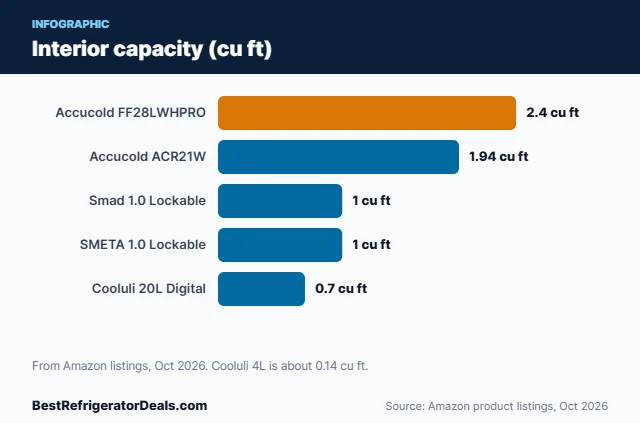
- Capacity: 2.4 cu ft (68 L)
- Dimensions: 18.5" W x 17.75" D x 24.88" H
- Control: Digital thermostat, internal fan
- Defrost: Automatic
- Refrigerant: Hydrocarbon, CARB compliant
- Warranty: 1 year
Accucold’s FF28LWHPRO is a general-purpose 2.4 cubic foot compact refrigerator with an internal fan and digital thermostat for steadier temperatures than a typical dorm fridge.
Automatic defrost.

2. Accucold ACR21W 1.94 Cu. Ft. Compact Medical Refrigerator
2. ACR21W shows high and low temperatures outside.
👍 Pros & Cons
Pros
- External temperature readout
- Self-closing door
- Compact
- Buffered probe
Cons
- No NSF 456 listing
- Small
- Expensive vs household minis
📄 Detailed Review
- Capacity: 1.94 cu ft (55 L)
- Dimensions: 18.88" W x 21.38" D x 23.13" H
- Monitoring: External readout, high/low
- Probe: Buffered
- Door: Solid, self-closing
- Use: Pharmaceutical storage
Accucold’s ACR21W is a 1.94 cubic foot pharmaceutical refrigerator with an outside readout of current and high/low temperatures, a buffered probe and a self-closing solid door.
Self-closing door.

3. Smad 1.0 Cu. Ft. Mini Fridge with Lock and Key, 12V/110V
3. Smad adds a lock for shared homes.
👍 Pros & Cons
Pros
- Lock and key
- Runs on 12V or 110V
- Quiet
- Reversible door
Cons
- Lower setting can reach freezing
- No external readout
- Add a thermometer for meds
📄 Detailed Review
- Capacity: 1.0 cu ft
- Dimensions: 15.75" W x 17.32" D x 19.68" H
- Range: 32–50°F
- Power: 110V AC and 12V DC
- Lock: Lock and key
- Listing: CE, ETL
Smad’s 1 cubic foot mini fridge has a lock and key, runs on 110V or 12V and lets you set 32°F to 50°F; for medicine, set it in the middle and verify with a thermometer.
Set mid-range and verify.

4. SMETA 1.0 Cu. Ft. Lockable Absorption Mini Fridge, 12V/110V
4. SMETA is silent for bedrooms.
👍 Pros & Cons
Pros
- Lock and key
- Silent
- UL listed
- 12V or AC
Cons
- Absorption is slow to recover
- Weaker in hot rooms
- Small
📄 Detailed Review
- Capacity: 1.0 cu ft (32 L)
- Dimensions: 16.1" W x 15.8" D x 19.7" H
- Cooling: Absorption, silent
- Modes: Max and Eco
- Power: AC and DC, AC priority
- Listing: UL
SMETA’s lockable 1 cubic foot fridge uses silent absorption cooling, offers Max and Eco modes and runs on AC or 12V DC.
Max and Eco modes.

5. Cooluli Concord 20 Liter Mini Fridge with Digital Thermostat
5. Cooluli 20L shows its setting.
👍 Pros & Cons
Pros
- Set and see the temperature
- Quiet thermoelectric
- Glass door
- Countertop size
Cons
- Thermoelectric struggles in warm rooms
- Can’t hold 36–46°F in heat
- Warm mode must not be used for meds
📄 Detailed Review
- Capacity: 20 L
- Dimensions: 13.8" W x 11.4" D x 16" H
- Control: Digital thermostat with display
- Modes: Cool or warm
- Power: AC and DC
- Door: Glass front
Cooluli’s 20-liter Concord has a digital thermostat with a display and a glass door. As a thermoelectric unit it works best in a cool, air-conditioned room.
Cool rooms only.

6. Cooluli Classic 4-Liter Mini Fridge (Cooler & Warmer)
6. Cooluli 4L is tiny and portable.
👍 Pros & Cons
Pros
- AC, car and USB power
- Very quiet, no compressor
- Warm mode
- Light enough to carry
Cons
- Cools relative to room temperature only
- Too small for food storage
- Not suitable for perishable meals
📄 Detailed Review
- Capacity: 4 L (6 cans)
- Dimensions: About 10.2" W x 7.7" D x 10.5" H
- Cooling: Thermoelectric, cooler and warmer
- Power: AC, 12V DC and USB cords included
- Noise: Ultra-quiet (no compressor)
- Use: Skincare, drinks, snacks
The Cooluli Classic is a 4-liter thermoelectric cooler and warmer that holds six cans. With no compressor it is very quiet, and it ships with AC, 12V DC and USB cords, which makes it easy to move between a nightstand, desk and car.
Only in air-conditioned rooms; never use warm mode for insulin.
How We Chose the Best Mini Fridge For Insulin
To choose the best mini fridge for insulin, we compared insulin coolers, GLP-1 pen cases and medication refrigerators sold on Amazon in the U.S. on how they cool (ice or gel packs, evaporative wallets, battery or plug-in electric, compressor), the temperature range each maker lists, how long passive cases say they stay cool, capacity in pens or vials, monitoring features such as displays and alarms, and locks. We read owner reviews for coolers that froze medication, displays that drifted and cases that ran warm. We are not medical professionals; always follow the storage directions on your medicine’s label and your pharmacist’s advice.
We checked storage temperatures against the FDA’s insulin storage guidance (36°F to 46°F in a refrigerator, up to 28 days between 59°F and 86°F for most vials and cartridges, never frozen), the official labels for Ozempic and Mounjaro on DailyMed, and the CDC’s vaccine storage unit guidance. Our full process is explained on our How We Test page. We do not list prices or star ratings because they change daily.
How to Choose the Best Mini Fridge For Insulin
Compressor beats thermoelectric
Compressor fridges hold set temperatures regardless of room heat.
Hold 36–46°F
The FDA range for refrigerated insulin.
Avoid freezing
Keep insulin off the back wall and out of freezer sections.
Use a thermometer
Dials are not precise.
Locks for shared spaces
Children and roommates.
Quiet for bedrooms
Absorption units are silent but slower.
Room temperature matters
Warm rooms challenge small fridges.
How to set up a new medicine fridge
Let a new unit stand upright for the time the manual specifies before plugging it in, then run it empty for a day with a thermometer inside. Only load medicines once it has held the target range steadily. Set dial thermostats to the middle and adjust in small steps, checking a few hours after each change.
Where to put the thermometer
Place the probe or thermometer in the middle of the cabinet, near the medicines, not against the walls or in the door. Buffered probes, sealed in glycol or a similar material, change temperature more slowly and better reflect what the medicine itself experiences.
Tips for Keeping Medication at a Safe Temperature
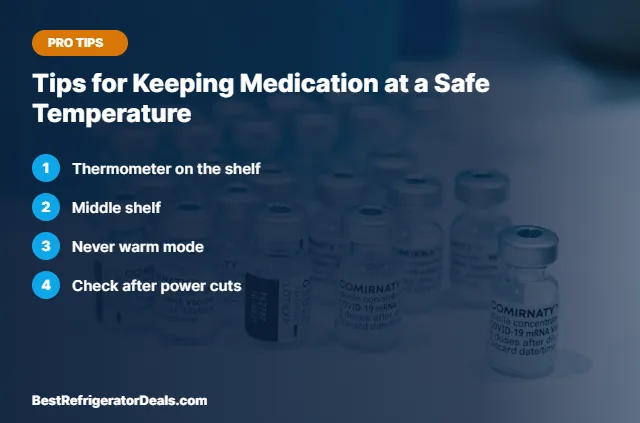
- Thermometer on the shelf. Next to insulin.
- Middle shelf. Not the back wall.
- Never warm mode. On cooler-warmers.
- Check after power cuts. Note the temperature.
Below are common questions readers ask about choosing the best mini fridge for insulin.
Frequently Asked Questions
What is the best mini fridge for insulin?
Accucold FF28LWHPRO for most people, ACR21W for medical-grade control.
Can a beverage mini fridge store insulin?
Only if it holds 36–46°F, verified with a thermometer.
Are thermoelectric mini fridges OK for insulin?
Only in cool rooms; they cannot cool much below room temperature.
Can a mini fridge freeze insulin?
Yes, if set too cold or if insulin touches the cooling plate.
Where should insulin go in a mini fridge?
On a middle shelf, away from the back wall and door.
Final Verdict
Accucold FF28LWHPRO is the best mini fridge for insulin for most people, with ACR21W for medical-grade control and Smad for a lock. Verify 36–46°F with a thermometer in the best mini fridge for insulin you choose.
Related Guides
More refrigerator research from Best Refrigerator Deals:
Prices and availability change often. Check the retailer listing for the current price, warranty and exact dimensions before you buy.