
As an Amazon Associate we earn from qualifying purchases. Commissions never affect our picks. Read our affiliate disclaimer.
A mini fridge runs around the clock, so a few dozen kilowatt-hours a year add up over its lifetime. To find the best energy efficient mini fridge, we compared listed annual energy use, ENERGY STAR status, capacity and defrost type across popular compact refrigerators sold in the U.S.
Below you will find our six picks, a side-by-side comparison, and a buying guide that explains how to read kWh numbers, why size matters more than you think, and a few habits that keep any compact fridge running efficiently.
Quick Answer: The Best Energy Efficient Mini Fridge
- Best OverallBLACK+DECKER BCRK32W
- Best SmallBLACK+DECKER BCRK17B
- Best Mid-SizeBLACK+DECKER BCRK25V
- Best Low-MaintenanceDanby Designer 3.2
- Best with FreezerManastin 4.5 Two-Door
- Best WarrantyMidea WHS-121LSS1
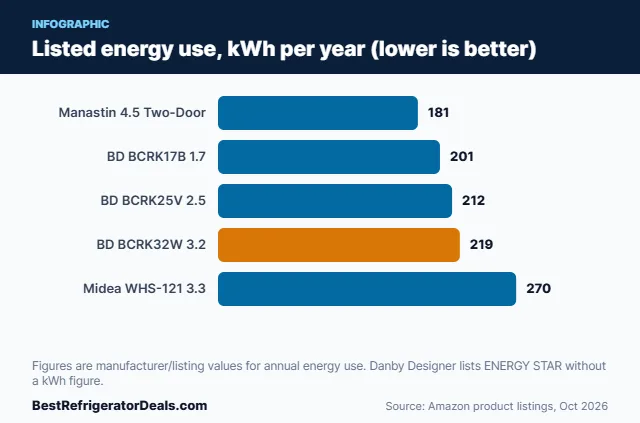
If you want one answer, the BLACK+DECKER BCRK32W is our pick for the best energy efficient mini fridge for most people: it is ENERGY STAR certified and lists 219 kWh a year while offering 3.2 cubic feet. Choose the BCRK17B if you only need desk-side drinks, or the Manastin if you need a real freezer.
Best Energy Efficient Mini Fridge Comparison Table
| Product | Best For | Type | Key Feature | Buy |
|---|---|---|---|---|
| BLACK+DECKER BCRK32W | Best Overall | Compact, chiller compartment | ENERGY STAR, 219 kWh/yr | Check Price |
| BLACK+DECKER BCRK17B | Best Small | Cube compact, chiller | 201 kWh/yr, under 20" tall | Check Price |
| BLACK+DECKER BCRK25V | Best Mid-Size | Compact, chiller compartment | 212 kWh/yr, 26.6" tall | Check Price |
| Danby Designer 3.2 | Best Low-Maintenance | Compact, full-width freezer section | Semi-automatic defrost | Check Price |
| Manastin 4.5 Two-Door | Best with Freezer | Two-door compact with freezer | 181 kWh/yr listed, 2 doors | Check Price |
| Midea WHS-121LSS1 | Best Warranty | Compact, chiller compartment | 2-year compressor warranty | Check Price |
The 6 Best Energy Efficient Mini Fridge Picks for 2026
Each best energy efficient mini fridge below was chosen for a specific need, from the smallest cube to a two-door model with a separate freezer.

1. BLACK+DECKER BCRK32W 3.2 Cu. Ft. Compact Refrigerator
1. The best balance of space and efficiency: 3.2 cubic feet, ENERGY STAR certification and a listed 219 kWh per year.
👍 Pros & Cons
Pros
- ENERGY STAR certified
- Holds 2-liter bottles in the door
- Two removable glass shelves
- Reversible door and leveling legs
Cons
- Manual defrost
- Chiller compartment is not a true 0°F freezer
- White finish shows scuffs
📄 Detailed Review
- Capacity: 3.2 cu ft (0.57 cu ft chiller)
- Dimensions: 17.7" W x 19.3" D x 32.7" H
- Listed energy use: 219 kWh/year
- Certification: ENERGY STAR, R600a refrigerant
- Defrost: Manual
- Storage: 2 glass shelves, 2-liter door bins
The BCRK32W is a 3.2 cubic foot single-door compact from BLACK+DECKER. It uses R600a refrigerant and a high-efficiency compressor, carries ENERGY STAR certification, and lists 219 kWh per year. Two glass shelves and full-width door bins make it practical for food as well as drinks.
For an efficiency-focused buyer, this is the sweet spot. It holds a week of drinks and lunches yet lists only 18 kWh more per year than BLACK+DECKER’s tiny 1.7 cubic foot model, so you get almost twice the space for a small energy premium.

2. BLACK+DECKER BCRK17B 1.7 Cu. Ft. Compact Refrigerator
2. The lowest listed energy use in our test group, in a cube that fits under a desk.
👍 Pros & Cons
Pros
- ENERGY STAR certified
- Lowest listed energy use in this size class
- Fits under most desks
- Door holds 1-liter bottles
Cons
- One shelf limits storage
- Manual defrost
- Chiller is for ice trays, not frozen meals
📄 Detailed Review
- Capacity: 1.7 cu ft (0.33 cu ft chiller)
- Dimensions: 17.5" W x 18.5" D x 19.7" H
- Listed energy use: 201 kWh/year
- Certification: ENERGY STAR, R600a refrigerant
- Power: About 70 watts (manufacturer)
- Defrost: Manual
The BCRK17B is BLACK+DECKER’s smallest compressor fridge. It stands under 20 inches tall, uses R600a refrigerant with an ENERGY STAR certified compressor, and lists 201 kWh per year. A removable glass shelf, a small chiller and a door bin for 1-liter bottles cover snacks and drinks.
If you only keep drinks and snacks cold, a smaller box is the most efficient choice you can make. The BCRK17B lists 201 kWh per year and draws about 70 watts while running, according to the manufacturer.

3. BLACK+DECKER BCRK25V 2.5 Cu. Ft. Compact Refrigerator
3. A middle size for people who want two shelves and 2-liter bottles without a full 33-inch cabinet.
👍 Pros & Cons
Pros
- ENERGY STAR certified
- Mid-height body fits beside a desk or counter
- Door bins hold 2-liter bottles
- Stainless-look finish
Cons
- Manual defrost
- Small chiller only
- Stainless look is vinyl, not steel
📄 Detailed Review
- Capacity: 2.5 cu ft (0.2 cu ft chiller)
- Dimensions: 17.5" W x 18.5" D x 26.6" H
- Listed energy use: 212 kWh/year
- Certification: ENERGY STAR, R600a refrigerant
- Defrost: Manual
- Finish: Stainless look
The BCRK25V sits between BLACK+DECKER’s smallest and largest compacts. At 26.6 inches tall it fits beside a desk or under many counters, while two glass shelves and door storage for 2-liter bottles give it more usable space than a cube fridge. It is ENERGY STAR certified and lists 212 kWh per year.
It suits a bedroom or office where a 33-inch fridge is too tall. Efficiency is close to the 1.7 model, and the stainless-look finish hides fingerprints better than plain white.

4. Danby Designer 3.2 Cu. Ft. Compact Refrigerator
4. ENERGY STAR certified with semi-automatic defrost, which helps keep frost from stealing efficiency.
👍 Pros & Cons
Pros
- ENERGY STAR certified
- Semi-automatic defrost cuts upkeep
- Full-width freezer section
- Trusted compact-appliance brand
Cons
- Plain white styling
- No digital controls
- Freezer section still shares one door
📄 Detailed Review
- Capacity: 3.2 cu ft (91 L)
- Dimensions: 17.68" W x 18.5" D x 32.72" H
- Certification: ENERGY STAR, R600a refrigerant
- Freezer: Full-width freezer section
- Defrost: Semi-automatic
- Finish: White
Danby’s Designer 3.2 is a counter-height compact with a full-width freezer section and semi-automatic defrost, which means less scraping than the manual-defrost units most rivals use. It is ENERGY STAR certified and uses R600a refrigerant.
Frost build-up insulates the cooling plate and makes a compressor work harder. Semi-automatic defrost reduces how often you need to clear ice, which helps the fridge keep running near its rated efficiency.

5. Manastin 4.5 Cu. Ft. Two-Door Mini Fridge with Freezer
5. A two-door 4.5 cubic foot fridge with a separate freezer and a listed 181 kWh per year.
👍 Pros & Cons
Pros
- Separate 1.0 cu ft freezer door
- Low listed 181 kWh/year
- Under 38 dB
- Crisper drawer for produce
Cons
- 41.5 inches tall: not under-counter
- Manual defrost
- Newer brand
📄 Detailed Review
- Capacity: 4.5 cu ft (1.0 cu ft freezer)
- Dimensions: 17.52" W x 17.13" D x 41.54" H
- Listed energy use: 181 kWh/year
- Thermostat: 7 levels
- Noise: Under 38 dB (manufacturer)
- Storage: 3 glass shelves + crisper
Manastin’s 4.5 cubic foot two-door fridge keeps a 1.0 cubic foot freezer behind its own door to limit odor transfer. Three glass shelves and a crisper drawer cover groceries, a seven-level knob sets the temperature, and the maker lists 181 kWh per year and under 38 dB.
Separate doors mean you do not dump freezer air every time you grab a drink. Note that this model is not marketed as ENERGY STAR certified, so treat the listed figure as the maker’s claim.

6. Midea WHS-121LSS1 3.3 Cu. Ft. Compact Refrigerator
6. A 3.3 cubic foot stainless compact with a 2-year compressor warranty.
👍 Pros & Cons
Pros
- Slightly more space than most 3.2 cu ft models
- Separate chiller compartment
- 2-year compressor coverage
- Stainless steel finish
Cons
- Higher listed kWh than ENERGY STAR rivals
- Manual defrost
- Basic mechanical controls
📄 Detailed Review
- Capacity: 3.3 cu ft
- Dimensions: 17.72" W x 18.58" D x 33.86" H
- Listed energy use: 270 kWh/year
- Controls: Mechanical adjustable thermostat
- Warranty: 1-year full, 2-year compressor
- Defrost: Manual
Midea’s WHS-121LSS1 is a 3.3 cubic foot single-door compact in stainless steel. It uses a mechanical thermostat, a separate chiller compartment and a reversible door, and Midea backs it with a 1-year full and 2-year compressor warranty. Listed energy use is 270 kWh per year.
It uses more energy than the ENERGY STAR models above (270 kWh listed), but it is a good choice if a longer compressor warranty matters to you and you want a stainless steel door.
How We Chose the Best Energy Efficient Mini Fridge
To choose the best energy efficient mini fridge, we started with compact refrigerators that list annual energy use or carry ENERGY STAR certification, then compared kWh per year against usable capacity. We favored models with R600a refrigerant and efficient compressors, checked dimensions and defrost type, and read verified owner reviews for patterns such as noisy compressors, frost build-up or poor door seals.
We checked efficiency claims against ENERGY STAR refrigerator guidance and food-safety temperatures against the FDA’s food storage advice (40°F or colder in the fridge, 0°F in the freezer). Our full process is explained on our How We Test page. We do not list prices or star ratings because they change daily.
Energy Efficient Mini Fridge Buying Guide
Read the yellow EnergyGuide label
Compact refrigerators sold in the U.S. show estimated yearly electricity use in kWh. Multiply that number by your electricity rate to estimate yearly cost. For example, 220 kWh at 17 cents per kWh is about $37 a year. Lower kWh at the same capacity means a more efficient fridge.
ENERGY STAR still matters
ENERGY STAR certified refrigerators must beat the federal minimum efficiency standard. According to ENERGY STAR, certified refrigerators are about 9% more efficient than models that only meet the minimum. Certification also means the number was tested under a defined procedure.
Compare kWh per cubic foot
A 1.7 cubic foot fridge almost always uses fewer kWh than a 4.5 cubic foot model, but it may cost more per unit of storage. Divide yearly kWh by capacity to compare value fairly, then buy the smallest size that fits your real needs.
Compressor beats thermoelectric for efficiency
Thermoelectric coolers are quiet, but they cool only a set number of degrees below room temperature and run constantly in warm rooms. A compressor fridge reaches true refrigerator temperatures and cycles off when cold, which is usually more efficient for anything larger than a personal cooler.
Defrost type and seals
Manual-defrost fridges are simpler and often more efficient, but you must remove frost once it reaches about a quarter inch. Check that the door gasket seals evenly; a weak seal can waste more energy than the difference between two models.
Tips to Lower Your Mini Fridge Energy Use
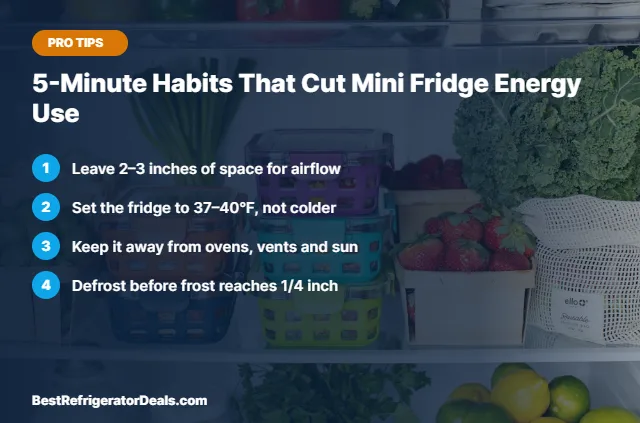
- Leave ventilation space. Keep a few inches around the back and sides so the condenser can release heat.
- Set it to 37–40°F. Colder than needed wastes energy; the FDA recommends 40°F or below for food.
- Keep it away from heat. Do not place it next to a radiator, oven or in direct sun.
- Defrost on time. Clear frost before it gets a quarter inch thick.
- Keep it reasonably full. A stocked fridge recovers temperature faster after the door opens.
Still deciding on the best energy efficient mini fridge? These are the questions shoppers ask most.
Frequently Asked Questions
What is the best energy efficient mini fridge?
For most people, the BLACK+DECKER BCRK32W is the best energy efficient mini fridge because it is ENERGY STAR certified, lists 219 kWh per year and still offers 3.2 cubic feet of storage. If you only need drinks, the 1.7 cubic foot BCRK17B lists even less at 201 kWh.
How much electricity does a mini fridge use?
Most compressor mini fridges list roughly 180 to 300 kWh per year. At about 17 cents per kWh, that is roughly $30 to $50 a year, depending on size, settings and room temperature.
Are thermoelectric mini fridges energy efficient?
Thermoelectric coolers use little power in absolute terms but run continuously and only cool a limited amount below room temperature. For keeping food safely cold, a compressor mini fridge is usually the more efficient choice.
Is ENERGY STAR worth paying for in a mini fridge?
Usually yes. ENERGY STAR certified refrigerators are about 9% more efficient than the federal minimum, and certification gives you a tested efficiency figure instead of a marketing claim.
Does a two-door mini fridge use more energy?
A two-door model with a true freezer may list more kWh than a single-door compact, but separate doors limit cold-air loss from the freezer. Compare the listed kWh per year rather than the door count.
Final Verdict
Our final pick for the best energy efficient mini fridge is the BLACK+DECKER BCRK32W, which pairs ENERGY STAR certification with useful 3.2 cubic foot capacity. Choose the BLACK+DECKER BCRK17B for the lowest listed energy use in a small cube, or the Manastin 4.5 Two-Door if you need a separate freezer.
Related Guides
More refrigerator research from Best Refrigerator Deals:
Prices and availability change often. Check the retailer listing for the current price, warranty and exact dimensions before you buy.